

Artificial intelligence has become an indispensable tool in our daily lives for many of us. While 2024 and 2025 saw a real boom, 2026 is shaping up to be the year of generative AI for businesses.
It is no longer enough to use generic tools. Organizations are looking to integrate this technology into their actual operations, using their own data and within a highly secure architecture.
When defining an AI implementation strategy for businesses, certain questions arise. How can AI be used in companies efficiently and securely? How is generative AI applied in a business? The trend is clear: a transition toward private and personalised AI. That is, models that fully understand the company’s data ecosystem and operate under its confidentiality standards.
Implementing artificial intelligence in a company may seem like a complex process from a technical standpoint and costly in economic terms. However, reality and our experience at Damavis have shown us that it is more than viable for any medium- or large-sized organisation. You don’t have to be a multinational corporation to have your own private AI assistant or agent.
In this article, we will address the key points for developing a custom LLM. Additionally, we will analyse why this solution guarantees total security compared to the use of tools like ChatGPT.
Public vs private generative AI
The use of commercial tools such as ChatGPT, Gemini, or Copilot has become widespread. In many cases, they lead to increased productivity. However, integrating these public models into internal operations carries a risk: the loss of control over information.
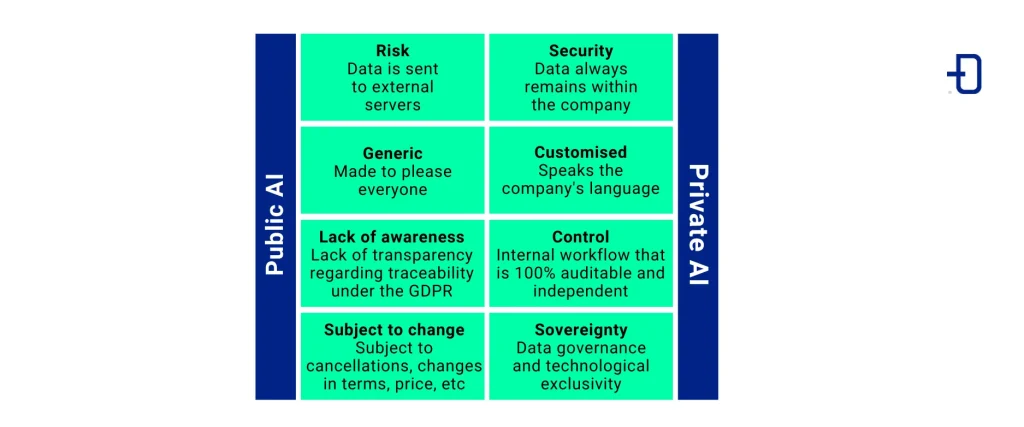
So, what is the difference between public and private AI? When we interact with public AI, the information or data we provide in the prompt is sent to external third-party servers, which may use it to train future models. However, it is true that some of these companies do allow this option to be disabled in their Enterprise version.
In the case of private AI, the model is deployed on the company’s infrastructure (whether on-premises or in the cloud). This ensures data security. As a result, when working with confidential documents or information (medical records, legal contracts, financial data, etc.), we ensure that they remain within the company’s security perimeter. Data privacy is, therefore, the key factor.
Another disadvantage of public AI compared to private AI is its generic nature. In other words, it is “designed to appeal to everyone.” In contrast, a private, customised AI is designed to meet the specific needs of an organisation. The underlying idea behind private AI is that it “speaks the same language” as the company. It not only knows its customers but also its operating manuals, internal processes, etc.
From conventional AI to generative AI
To understand just how useful artificial intelligence is, it is essential to understand its evolution. From the traditional conversational chatbot to what we now know as an AI assistant or agent, there have been major advancements.
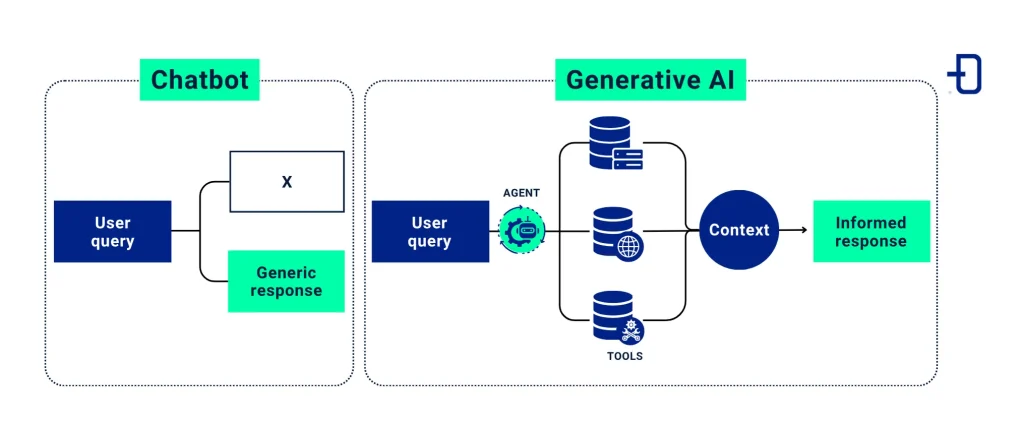
The traditional way we used to interact with machines was through a conversational chatbot. These systems are characterised by rigid rules and a decision tree. Thus, the user must follow a predefined information flow to get a response. The problem is that if the user deviates from this pre-established script, the system fails. Therefore, it is a reactive and limited form of AI.
How an AI agent or assistant works
However, the landscape has changed completely thanks to the arrival of AI assistants or agents. Unlike a chatbot, an AI agent has the ability to reason and synthesise information and is not limited to following a set script. In this sense, it is a proactive technology that understands the context of the query. Furthermore, it is capable of suggesting alternative approaches.
This key difference between chatbots and generative AI translates into a clear advantage for intelligent systems:
- Contextual understanding. An AI agent is capable of understanding the user’s intent and analysing the context even in ambiguous situations. In contrast, a chatbot is limited to searching for keywords in the information stream and issuing a predefined response.
- Responsiveness. While a conversational chatbot merely responds, an AI assistant goes further. It can search a database, consult various documents, and connect pieces of information to provide a comprehensive and detailed response.
- Quality of information. Custom generative AI generates unique and accurate responses. These responses are based on the knowledge it has acquired from the information, documents, and data provided by the company. Traditional AI, on the other hand, offers rigid, scripted responses based on a predefined flow.
What is private AI
The concept of private AI refers to the ability to deploy artificial intelligence models within a company’s private infrastructure. As we’ve already mentioned, when working with public AI, queries are sent to external servers. However, private AI can be hosted either on local infrastructure (on-premises physical servers) or in a virtual private cloud.
Thus, implementing private AI means being able to work as securely as possible. By not relying on external elements such as third-party APIs, it is ensured that information does not leave the company. This prevents leaks and keeps confidential data safe.
Advantages of private generative AI
In addition to data security, what other advantages do these systems offer?
- Data control and governance. The company has the authority to decide which models to use, how to configure them, and who has access to them.
- Performance and technological sovereignty. Deploying private AI ensures consistent performance. It can also speed up processes, as it does not rely on third-party services. Furthermore, it is not subject to system outages, price changes, or the terms of service of external providers.
- Regulatory compliance. It facilitates compliance with regulations, particularly the GDPR, as the flow of information is internal and auditable.
In summary, implementing private AI guarantees technological independence and exclusivity.
How to implement AI in a company while ensuring complete data security
Implementing a private AI project within a company can be a challenge for any IT manager. However, the key lies in integrating the architecture with every single technological component of the organisation.
In this section, we will cover the technical foundation for building AI using your own data. We will also provide a step-by-step explanation of the methodology to follow for a successful implementation.
Architecture of a RAG
First, let’s start by defining what a RAG is. RAG stands for Retrieval Augmented Generation, and it is an AI technique that enables a language model (LLM) to provide improved and accurate responses based on information provided by a user.
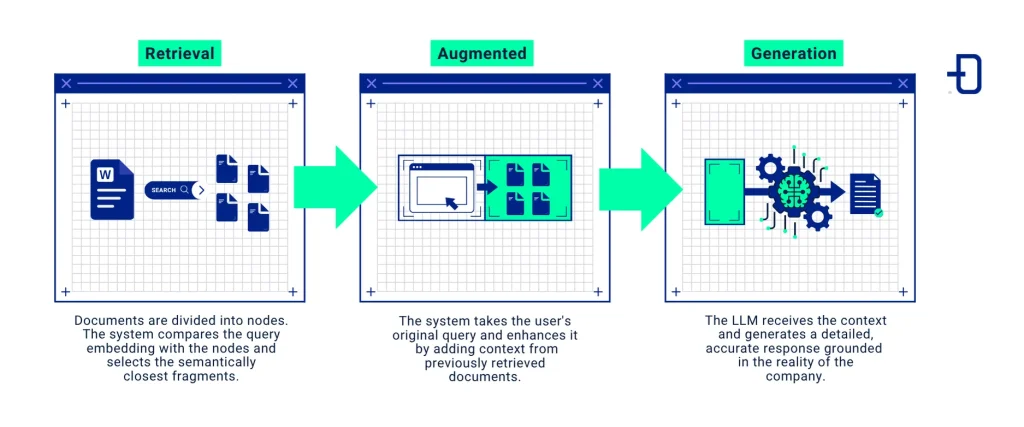
So, how does a RAG work? In articles such as Retrieval Augmented Generation: What is RAG? and RAG implementations and extensions, we have already explained in detail the technical foundation behind this concept. In short, a RAG consists of three phases:
- Retrieval. This component is responsible for searching documents for relevant pieces of information that can answer the user’s query. It works as follows:
- First, the documents are divided into smaller units, of a predefined maximum length, called nodes.
- Once these nodes are obtained, their associated vectors are calculated using an embedding model.
- When a user submits a query to an RAG system, the embedding corresponding to that query is calculated. The system then uses a proximity metric in the vector space. Next, it selects the text nodes whose vectors are semantically closest to that query.
- Augmented. In this phase, the system takes the user’s original query and “augments” (enriches) it with the context of the documents it has previously retrieved.
- Generation. Once the most relevant documents for answering the question have been retrieved, the RAG generates a response based on that information.
Vector databases and embeddings
For an RAG to function as efficiently as possible, it is essential that the information provided be semantically understandable to a machine. This is where data engineering comes into play. Here, vector databases and embeddings play a key role.
As we’ve mentioned in previous articles, embedding involves representing words, phrases, paragraphs, or documents as numerical vectors that capture their semantic meaning. When a user queries a RAG system, the embedding corresponding to that query is calculated.
When working with highly dimensional data such as text embeddings, traditional databases (those based on SQL and also a large portion of NoSQL databases) are unable to handle this data appropriately. For this reason, there are systems specialised in this specific type of data: vector databases. As detailed in Vector database: What it is and how it works, their main advantage is that they implement indexes and algorithms optimised for these use cases.
Data security
The ultimate goal of implementing private generative AI is to ensure data security. The approach to achieving this may vary depending on the company’s needs.
- On-Premise. The data and information that feed the models are hosted on physical servers located on the organisation’s own premises. This provides complete isolation but requires a significant investment in financial resources and physical space.
- Private Cloud. The solution is deployed in a private cloud (such as Google, AWS, etc.) owned by the company. In this case, data security is also complete. Only users designated by the organisation can access the data. Additionally, this option leverages all the scalability and flexibility that the cloud provides.
In any case, it is essential to understand that by using commercial tools, the user is accepting that the data they share will travel to external servers and lose all traceability. In contrast, implementing private AI eliminates any possibility of data leaving the corporate environment.
Cost of implementing AI in a business
Another common concern that arises when considering the implementation of private AI in a corporate environment is: How much will it cost to use customised artificial intelligence in my business? Unfortunately, there is no exact answer; it will depend on the scope of the project.
However, we will try to clarify the costs associated with launching a project of this nature. Furthermore, we will not only analyse the expenses but also focus on the operational efficiency it generates.
Commercial tools typically operate on a per-user subscription payment model. In contrast, a private AI solution involves a number of associated costs.
Analysis and configuration
This refers to the initial cost of designing the architecture to fit the company’s technology stack. In addition to deploying the model, we factor in the creation of embeddings and the database that will store all the information.
During this preliminary analysis, at Damavis we guide clients in choosing the model size that best fits their needs. Working with a 7B-parameter model is not the same as working with a 14B or 70B model in terms of cost. Likewise, the largest and most expensive model isn’t always necessary for specific tasks. You can experiment with different options, and this optimisation is what will determine the savings on infrastructure usage bills.
Infrastructure implementation
In this phase, the configuration defined in the analysis is implemented, and the RAGs are created. The costs incurred here depend on computing usage (servers). Typically, for medium to high query volumes, the cost of using local models is lower than that of paid public APIs, in addition to offering the privacy and security benefits mentioned earlier.
Maintenance and updates
The cost of maintaining and updating the system is generally low. The RAG architecture allows new information to be added without the need to retrain the model. Even so, it is important to keep in mind the need for periodic maintenance tasks to ensure the system runs smoothly. In this regard, actions such as updating prompts, monitoring the quality of responses, or verifying that newly added documents maintain the same fragment size can lead to increased costs.
In short, setting up a private AI project within a company requires a moderate initial investment to configure the environment, deploy the architecture, and integrate the components into the organisation. Once the system is up and running, costs remain constant and predictable.
ROI of generative AI for businesses
The added value of an AI assistant or agent lies in its ability to free up manual workloads and automate tasks. So, what is the ROI of generative AI for businesses? Our experience in Damavis using these tools shows that improved task performance (and, consequently, a positive ROI) can be seen in the short term.
The ROI is not only reflected in the savings in hours/person. It is also evident in the elimination of human errors during critical processes and in the ability to make decisions based on real-time data and information.
Conclusion
Generative AI for businesses has gone from being a promise to a reality for organisations seeking to improve their operational efficiency. As we’ve discussed, it is no longer a technology available only to a select few but can be applied across various fields.
In today’s world, integrating artificial intelligence systems is almost a necessity when it comes to achieving added value and a significant competitive advantage in the race for industry leadership.
Many companies have integrated AI into their internal operations, but they prohibit the use of commercial tools like ChatGPT out of fear of data leaks or uploading confidential information. At Damavis, we help you implement private generative AI for businesses, ensuring you don’t have to share sensitive information with third parties.
If you found this article interesting, we encourage you to visit the Data Science category to see other posts similar to this one and to share it on social networks. See you soon!
