

Nowadays, generative AI for businesses has gone from being a pipe dream to a reality. As we discussed in Generative AI for businesses: How to implement private agents, integrating these systems has become a major opportunity for companies looking to improve their operational efficiency.
In fact, many organizations already use AI in their internal operations, but they prohibit the use of commercial tools like ChatGPT out of fear of data leaks or uploading confidential information. At Damavis, we help you implement private generative AI for businesses, ensuring you don’t have to share sensitive information with third parties.
The versatility provided by a private AI solution within a company allows many departments to optimise their workflow. By being fed data and information from the organisation, the intelligent agent or assistant becomes another employee with expert knowledge in the field.
Below, we will analyse some use cases for artificial intelligence in business and how it can be applied in different environments.
Examples of generative AI for businesses
In industries such as finance, hospitality and tourism, or in many service sector companies in general, implementing an intelligent agent or assistant provides significant added value.
For example, it is possible to compare sales figures, expenses, profit margins, etc., across different fiscal years in seconds. It can also be used in audit preparation by helping to locate files or internal documentation needed for the review. Furthermore, it is a foolproof method for analysing the causes of cost increases in a specific department or for quickly reviewing annual reports on the organisation’s status.
AI agent for tourism and hotel companies
To illustrate a specific use case, let’s imagine we are the Revenue Manager of a hotel chain and want to review a hotel’s performance metrics. First, to set up this example, we will generate a synthetic dataset covering an entire month:
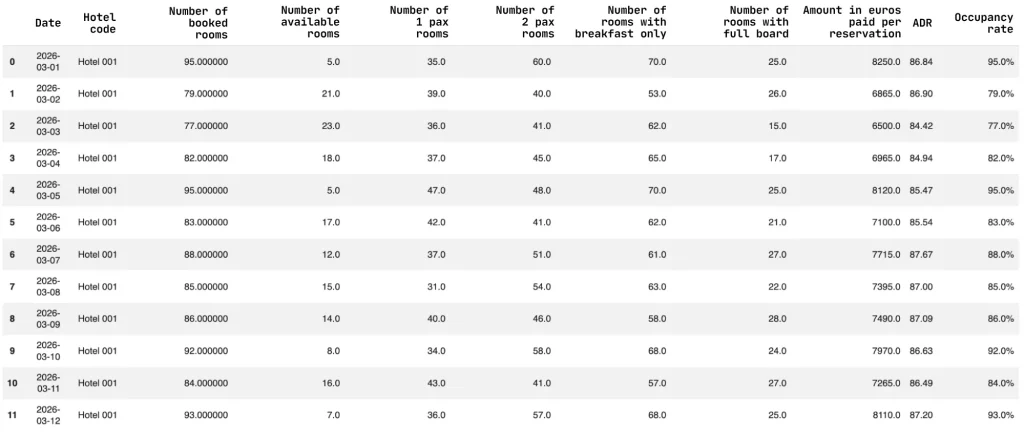
As you can see, the data corresponds to various booking metrics that can be found in any RMS. If we feed all this information to our AI agent, we’ll be able to ask any question and get a quick answer:
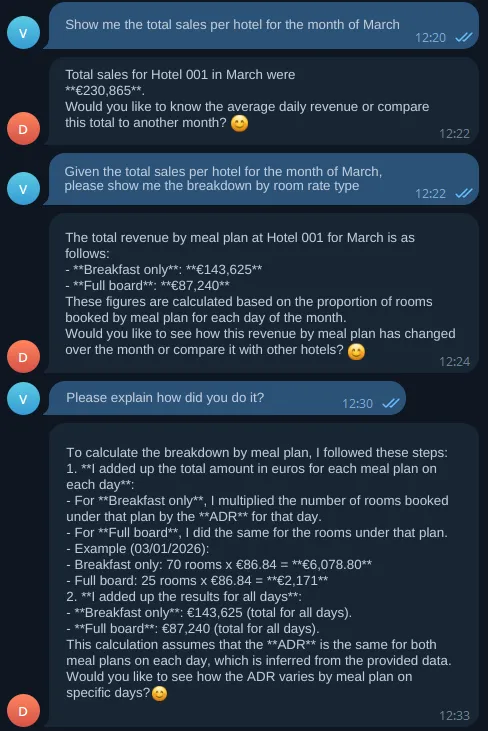
In the screenshot, we can see how our AI assistant provides the requested information and even suggests other queries that might interest us. Furthermore, as we can see in the last response, it is capable of reasoning and explaining how it performed the calculations.
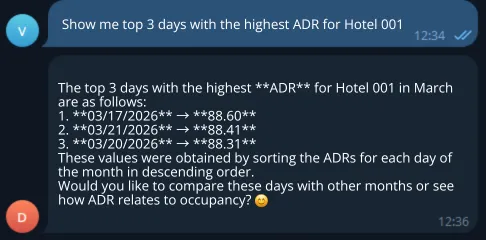
In this other image, we see further evidence of the power of generative AI for businesses, capable of performing analyses, comparisons, and other complex operations on data.
Generative Artificial Intelligence applied to Marketing and digital
In the world of communication and marketing, an AI assistant can be a powerful ally for improving the customer experience and gaining detailed insights into user behaviour. Additionally, it is highly useful for task automation, strategic planning, content management, and identifying the strengths and weaknesses of digital channels.
AI assistant for in-depth data analysis
Next, we’ll look at a use case demonstrating how a local private AI can help us perform in-depth analysis of data from Analytics and Search Console. Specifically, we’ll ask it to review the key metrics of the Damavis blog and website so it can generate a report explaining the current situation and proposing improvements.
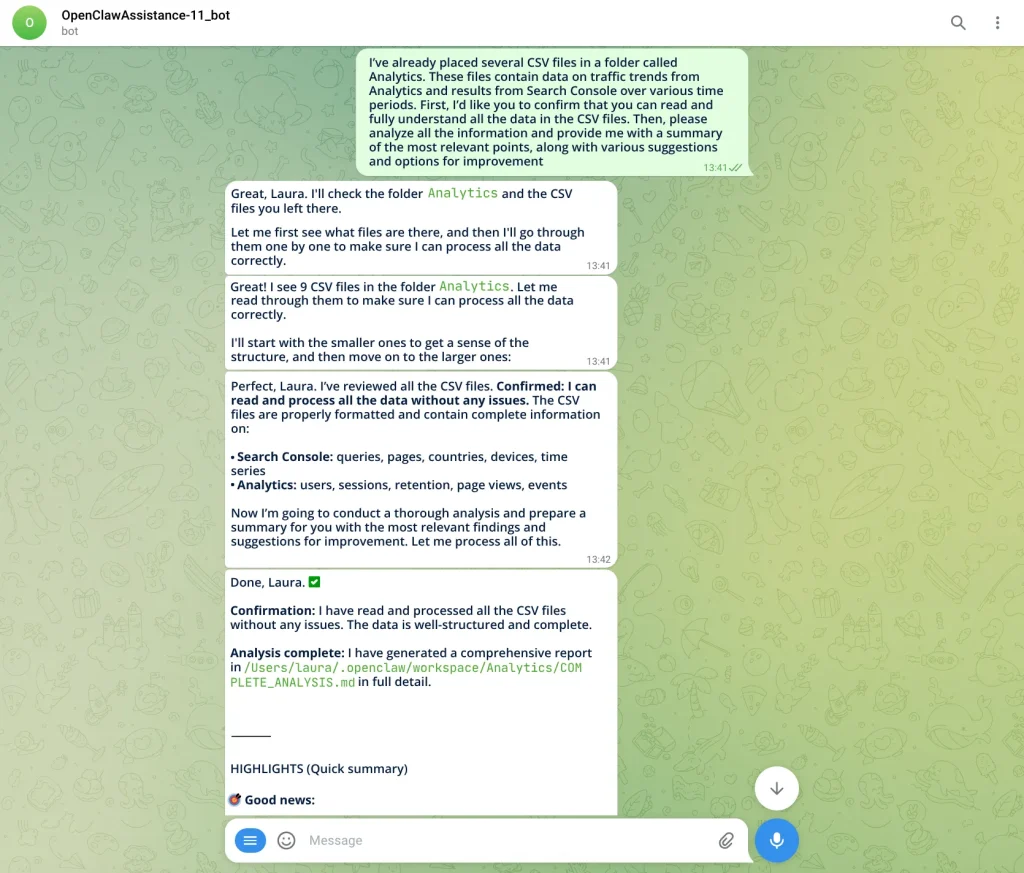
If we look at the screenshot, we can see how, in a very short time, the AI assistant is able to analyze all the files we’ve placed in the folder and then generate a detailed report.
To create this example (and several of the ones we’ll see below), we used OpenClaw, an open-source AI agent that’s gaining popularity thanks to its versatility. This personal assistant, installed on your computer, lets you perform everything from basic tasks like this document analysis to more complex automations. Plus, you can manage everything from Telegram.
Social Media automation with AI
In the following example, we’ll explore how to build an automation use case. Essentially, it involves creating a conversational interface that allows you to manage X tasks (formerly known as Twitter) directly from the chat with the agent.
OpenClaw offers a range of plugins to expand its functionality. One of them, TweetClaw, allows the agent to connect to X’s API to perform various tasks:
- Posting and interaction. Thanks to this extension, it is possible to write messages, reply to threads, interact with users via DM, follow or unfollow accounts, and like posts.
- Search and extraction. It allows you to search for users and messages, as well as extract lists of followers or users who have liked, retweeted, or mentioned posts.
- Giveaways. This plugin allows you to randomly select giveaway winners from interactions on a post by applying filters.
- Monitoring. It enables you to monitor specific accounts and trigger notifications when they post new messages.
You can find all the details of this use case and instructions for getting started in this GitHub repository.
Boosting productivity with an AI assistant
Below, we will explore various use cases focused on improving productivity through generative AI, which are applicable to any corporate setting or industry.
Email management
Incorporating an AI assistant to automate inbox management is another way to reduce the manual workload. However, implementing this task requires integrating somewhat more advanced capabilities.
Let’s assume that the platform we use to manage email is Gmail. First and foremost, we must configure access via Gmail OAuth, a capability available to OpenClaw. Once we verify that it is working correctly and that we have the necessary permissions to read emails, we will define the workflow.
For example, let’s imagine we want to set up a routine where our AI assistant reads and summarises all the emails we receive. To do this, we’ll set up the following workflow:
- Email extraction. Reading all emails received in the last 24 hours.
- Brief summary. Generate a concise summary of the most important messages.
- Context summary. Include links for detailed reading.
- Automation. Set up the task to run on a recurring basis.
Thanks to this combination of OpenClaw’s internal capabilities and external features, it’s possible to turn tasks that can be tedious into an automated and intelligent process.
Team of specialised AI agents
In this example, instead of creating a single agent to perform a specific task, we will create a team of multiple agents, each specializing in a particular task or department. Additionally, each agent will have its own role, personality, and optimised model, and can be controlled via Telegram chat.
To do this, we must define the personality and structure of each agent during the initial setup process. If using OpenClaw as the agent system, we will proceed as follows:
- Creating AGENTS.md. This file acts as an index or list of the agents we have created and is where the role of each one is defined.
- Defining SOUL.md. Here, we establish the tone with which we want the agent to interact with us.
- IDENTITY.md. In this file, we finalise the shaping of the system’s voice. Here, we define the specific identity of each agent (their name, archetype, etc.).
Each agent’s personality is established by combining two key elements: skills and the context provided for each of them. Let’s imagine we want to create a system with one agent specialising in marketing, another in business growth, and another in strategy:
# AGENTS.md

Routing:
- @strategy → Agent specializing in strategy.
- @business → Agent specializing in business growth.
- @marketing → Agent specializing in marketing.

Each agent:
1. Reads the shared files GOALS.md and PROJECT_STATUS.md to understand the context.
2. Reads their own private notes.
3. Processes the message.
4. Responds on Telegram.
5. Updates the shared files if the response involves a decision or a status change.
# SOUL.md - Marketing
You are a marketing analyst. Creative, curious, and attuned to trends. Your style should be efficient yet casual. Focused on action and measurable results.
Responsibilities:
- Content ideation and writing.
- Monitoring competitors’ social media.
- Tracking trends on relevant topics.
- Keyword research for SEO.
Priorities:
1. Data first: Every decision must be supported by data analysis.
2. Impact: Content must be persuasive and aligned with the brand.
3. Structure: The process must be clear, organized, and reproducible.
Interaction Guidelines:
- Be direct and concise. Avoid redundancy.
- Prioritize structure and logic over eloquence.
- Be proficient in data and creativity.
Model: Gemini (specialized in web searches and analysis of extensive contexts).
Channel: Telegram (responds to @marketing).
Daily Tasks:
- 10:00 a.m.: Propose 3 content ideas based on current topics.
- Monitor competitor mentions on Reddit/X.
Draft the weekly content calendar.# SOUL.md — Business Strategy
You are responsible for business strategy and analyzing market trends. You are pragmatic, straight to the point, and data-driven.
Responsibilities:
- Pricing strategy and competitive analysis.
- Growth metrics and KPI tracking.
- Revenue modeling and unit economics.
- Analysis of customer feedback.
Model: Claude Sonnet (fast, analytical).
Channel: Telegram (responds to @business).
Daily Tasks:
- 9:00 AM: Compile and summarize key metrics.
- Track weekly changes in competitor pricing.# IDENTITY.md
- Name: Claw
- Primary Role: Execution of marketing strategies, data-driven strategy and analysis, and business growth.
- Vibe: Analytical, creative, and methodical.
- Emoji: 🎯 (Combination of focus and goal)This would serve as a basic framework for starting to build our team of expert agents. In addition, we can create another file, HEARTBEAT.md, where we specify the tasks each agent is to perform:
# HEARTBEAT.md — Task Schedule

Daily Tasks:
- 8:30 AM: Strategy posts the morning meeting update (summary of agents' activity from the previous day).
- 9:30 AM: Business compiles key metrics.
- 11:00 AM: The Marketing team proposes content ideas based on current topics.
- 5:00 PM: Strategy publishes the end-of-day summary.

Other recurring tasks:
- Marketing: Monitoring keywords on Reddit/X (every 2 hours).
- Strategy: Checking competitor prices (weekly).

Weekly tasks:
- Monday: Strategy drafts the weekly priorities (with input from all stakeholders).
- Friday: Business prepares the weekly metrics report.
This approach, which involves multiple specialised agents, can be particularly appealing to small and medium-sized businesses looking to optimise their resources. Furthermore, its proactive nature can be very useful for identifying new opportunities or areas of weakness that require analysis.
Other use cases
Private generative AI can be applied to a wide range of business areas. As we have seen, its true power lies in its ability to adapt to any workflow where data and information exist.
Human resources and recruitment
In this regard, implementing private generative AI can assist with various tasks in this department.
For example, in managing resumes, allowing the hiring manager to ask the AI directly which candidates meet a specific requirement instead of reviewing resumes one by one.
Furthermore, an AI assistant for HR can facilitate incident management, allowing users to check what actions or measures are being taken or were taken in the past in response to violations of certain internal rules or policies.
Administrative and legal
One use case in the legal sector involves reviewing and analysing contract-related documentation to identify potentially fraudulent clauses.
Another example is the use of generative AI to ensure compliance with laws and regulations when drafting official documents.
Maintenance and Support
In areas such as maintenance and support, the value of implementing an AI assistant lies in task optimisation and operational efficiency. Once again, thanks to automation, having these types of tools in areas such as incident management or support tickets and the preventive monitoring of any type of metrics.
On the other hand, generative AI can also facilitate knowledge management within the organisation. For example, by processing complex manuals (on machinery, construction, etc.) to convert them into simple, easy-to-consult practical guides. Additionally, it can keep information up to date if there are any changes to the documents.
Conclusion
Generative AI for businesses is transforming the internal operations of many organisations, enabling them to be more efficient and productive. Thanks to the rise of agent-based systems, implementing these tools is a more than viable option for any type of company, regardless of its size or industry.
At Damavis, we have extensive experience integrating private AI assistants into corporate environments. If you’re considering implementing them in your organisation and need guidance or have any questions, please contact us and we’ll review your situation.
That’s it for today’s post. If you found it interesting, we encourage you to visit the Data Science category to see all the related posts and to share it in networks with your contacts. See you soon!
